How “AI-Washing” Is Putting HR and Business Leaders at Risk
Let’s be clear on two realities that may seem contradictory, but both are true and highly relevant for leaders today:
1. AI will transform how organisations manage people and talent.
Well-designed, ethical, and properly implemented AI will absorb a significant portion of administrative and operational HR work. It has the potential to improve efficiency, decision-making, workforce planning, and employee experience.
For managers and HR leaders who build the right capability, this is a significant opportunity to elevate their role from operational to strategic.
2. Much of what is currently being sold as “AI” is not fit for purpose.
A large portion of AI tools in the HR and recruitment space are overstated, underdeveloped, or simply rebranded automation.
These systems often:
- Lack true learning capability
- Fail to understand context or nuance
- Are trained on poor or biased data
- Present real risks around compliance, privacy, and discrimination
- Overpromise outcomes but underdeliver in practice
For organisations, this is not just a technology issue. It is a risk, governance, and decision-making issue.
Why This Matters for Managers and HR
Unlike recruitment agencies, internal HR teams and managers are accountable for broader outcomes:
- Workforce capability and performance
- Employee experience and retention
- Compliance and legal risk
- Organisational culture and fairness
Adopting ineffective or misleading AI tools can directly impact all of the above.
The risk is not only financial. It is strategic:
- Missing high-quality talent due to poor systems
- Making flawed people decisions based on inaccurate insights
- Introducing bias into hiring or performance processes
- Eroding trust internally
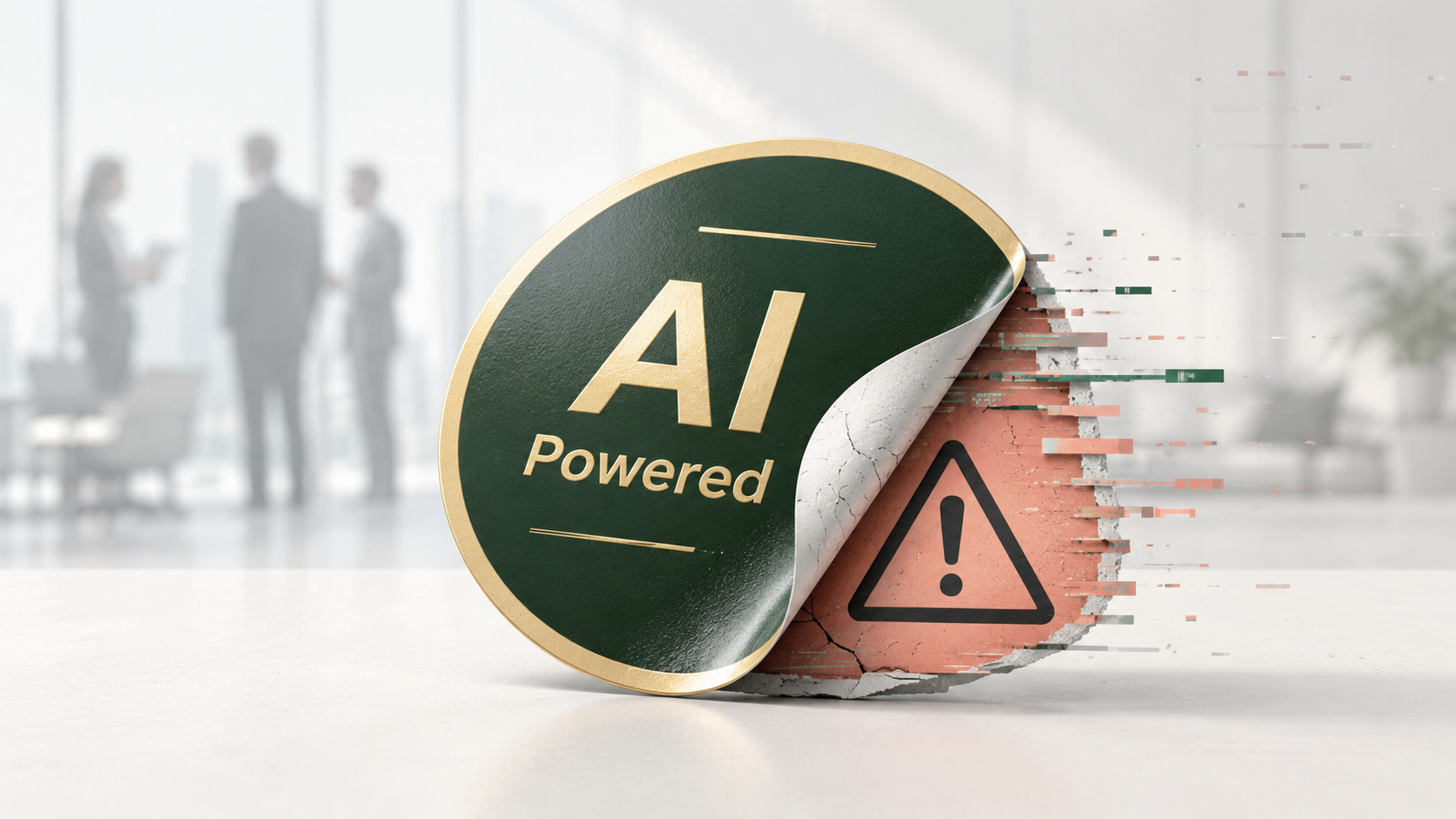
The Reality of “AI-Washing”
Many platforms marketed to HR teams rely on outdated logic dressed up as modern AI.
Common patterns include:
- Keyword matching presented as “intelligent screening”
- Basic automation labelled as “machine learning”
- Rule-based systems positioned as “cognitive decision-making”
- Inflated accuracy claims based on irrelevant metrics
In practice, these tools:
- Struggle with different terminology for the same role
- Cannot interpret context or intent
- Fail to recognise transferable skills
- Require manual oversight because outputs are unreliable
What Real AI Should Deliver
For HR and managers, real AI should support better decisions, not just faster processes.
Effective AI systems should be able to:
- Understand context, not just keywords
- Recognise equivalent skills and varied career paths
- Interpret nuance, including negation and intent
- Improve over time based on data and usage
- Provide transparent and measurable performance metrics
For example:
- Recognising that “led a team” aligns with leadership capability
- Understanding that experience in one industry may translate to another
- Identifying potential, not just direct experience
The Hidden Cost to Organisations
When businesses adopt poor-quality AI tools, the impact is often underestimated:
- High-quality candidates or internal talent are overlooked
- Managers lose confidence in systems and revert to manual processes
- HR teams spend more time validating outputs than gaining efficiency
- Organisations make slower, less informed decisions
- Budget is allocated to tools that do not deliver meaningful value
In many cases, companies are paying premium prices for technology that performs at a basic level.
What HR Leaders and Managers Should Be Asking
Before adopting any AI-driven HR or recruitment solution, leaders should challenge vendors with practical, outcome-focused questions:
- Can you demonstrate accuracy using real data from our market?
- How does the system handle different terminology for the same role or skill?
- How does it identify transferable or adjacent capabilities?
- What happens with incomplete or messy data?
- How does the system improve over time, specifically?
If clear, evidence-based answers are not provided, that is a signal to proceed with caution.
The Path Forward
This is not about avoiding AI. Quite the opposite.
HR and business leaders should be:
- Actively engaging with emerging technology
- Building internal capability to assess and implement it properly
- Defining what should remain human versus what can be automated
- Ensuring governance, compliance, and fairness are built into any solution
The organisations that succeed will not be those that adopt AI fastest, but those that adopt it most intelligently.
Final Thought
The question is not whether AI will play a role in HR and workforce management. It already is.
The real question for leaders is:
Will you invest in tools that genuinely enhance decision-making and performance, or continue to pay for solutions that simply repackage outdated processes?
Because the difference will directly impact your people, your culture, and your business outcomes.