
Maximising ROI on Recruitment

How to Calculate the True Cost of Not Filling Critical Roles
Most businesses know what they spend on recruitment.
Agency fees. Job ads. Internal salaries. Screening tools. Interview time. Onboarding.
What is less visible is what recruitment is costing the business when critical roles remain open for too long, when the wrong person is hired, or when hiring starts from scratch every time a vacancy appears.
That is where recruitment ROI becomes a far more important conversation.
Recruitment return on investment is not simply about reducing spend. It is about understanding whether your hiring function is creating measurable business value. Are roles being filled quickly enough? Are the right people being appointed? Are new hires staying, performing and strengthening the business over time?
For growing businesses in construction, engineering, manufacturing and infrastructure, this matters. Project timelines, client commitments, operational capacity and leadership bandwidth are all directly affected by hiring performance.
A vacant critical role is not just a recruitment issue. It is a business cost.
The hidden cost of an unfilled role
When a key position remains vacant, the cost rarely appears as a single line item.
Instead, it shows up across the business.
Projects slow down. Managers absorb additional work. Existing employees stretch beyond capacity. Decisions are delayed. Opportunities are missed. Customers and clients may feel the impact. Internal teams may become frustrated by the extra load.
The longer the role remains open, the more those costs compound.
A vacant role can affect:
- Lost productivity
- Delayed project delivery
- Reduced team capacity
- Increased workload for existing employees
- Management time spent covering gaps
- Lower morale and engagement
- Missed revenue or operational opportunities
- Greater pressure to make a rushed hiring decision
This is why looking only at agency fees or advertising costs gives an incomplete picture. The more important question is not, “How much does recruitment cost?”
The better question is, “What is it costing us not to hire well, quickly and consistently?”
Why traditional recruitment models often fall short
Many businesses still recruit reactively.
A role becomes vacant. A job ad is posted. A recruiter is briefed. Candidates are reviewed. Interviews are arranged. An offer is made. Then the process stops until the next vacancy appears.
This can work when hiring is occasional.
It becomes far more expensive when the business is growing, project demand is increasing, or multiple critical roles are open at the same time.
Reactive hiring creates three common problems.
First, there is no retained pipeline. Every search starts from zero, which increases time-to-fill and reduces access to passive candidates.
Second, costs are unpredictable. Per-hire agency fees can quickly escalate when hiring volumes increase.
Third, hiring quality can become inconsistent. When teams are under pressure to fill roles quickly, process discipline often drops. That can lead to poor fit, early attrition and repeated recruitment cycles.
This is where recruitment ROI needs to be measured beyond the upfront cost of hiring.
What recruitment ROI should actually measure
Recruitment ROI should assess both efficiency and business impact.
The most useful metrics include:
Time-to-fill
How long does it take to fill a role from vacancy approval to accepted offer or start date? For critical roles, every additional week has a cost.
Cost-per-hire
What is the total cost of filling a role, including agency fees, advertising, internal time, tools, assessments and onboarding?
Quality of hire
Is the new hire performing, contributing and aligning with the business? A fast hire is not valuable if the appointment is wrong.
Offer acceptance rate
Are the right candidates accepting your offers, or are they being lost late in the process due to salary misalignment, delays or competing opportunities?
First-year retention
Are new hires staying beyond the first 6 to 12 months? Early attrition is one of the clearest signs that the recruitment process is not delivering a return.
Hiring manager satisfaction
Are managers receiving strong shortlists, clear communication and candidates who genuinely match the brief?
Candidate experience
Is the process strengthening or damaging your reputation in the market?
Together, these metrics show whether recruitment is functioning as a cost centre or a capability that supports growth.
A simple way to calculate the true cost of vacancy
To calculate the cost of not filling a critical role, start with three practical inputs.
1. Daily salary cost
Take the role’s annual salary and divide it by the number of working days in the year.
For example, a role with a $120,000 salary has a daily salary equivalent of roughly $460.
2. Productivity or business impact multiplier
For critical roles, the cost of vacancy is often higher than the salary equivalent. A manager, project lead, engineer, estimator, operations leader or technical specialist may create value well beyond their base salary.
A practical estimate is to apply a multiplier of 1x to 1.5x the daily salary equivalent, depending on the role’s impact.
Using the same $120,000 role:
- 1x daily impact = approximately $460 per day
- 1.5x daily impact = approximately $690 per day
3. Days vacant
Multiply the daily vacancy cost by the number of days the role remains unfilled.
If that role stays vacant for 60 days, the cost exposure could sit between $27,600 and $41,400.
That is before factoring in manager time, team pressure, delayed projects, rework, agency spend or onboarding.
For businesses with multiple vacancies, the numbers can become significant very quickly. That’s why we’ve created a unique RPO Calculator, that can show you exactly what recruitment is costing you, and what you could save.
Three questions. Thirty seconds. A number that might surprise you. Give it a go.
The cost of a wrong hire
Vacancy cost is only one part of the ROI equation.
A poor hiring decision can be even more expensive.
The cost of a wrong hire may include:
- The original recruitment cost
- Time spent interviewing and onboarding
- Lost productivity during the ramp-up period
- Impact on team morale
- Management time spent addressing performance issues
- Client or project disruption
- The cost of replacing the person
- Further vacancy time while the role is reopened
This is why speed without quality is not a solution.
The strongest recruitment model is not simply the fastest. It is the one that reduces time-to-fill while improving fit, performance and retention.
Where RPO changes the ROI equation
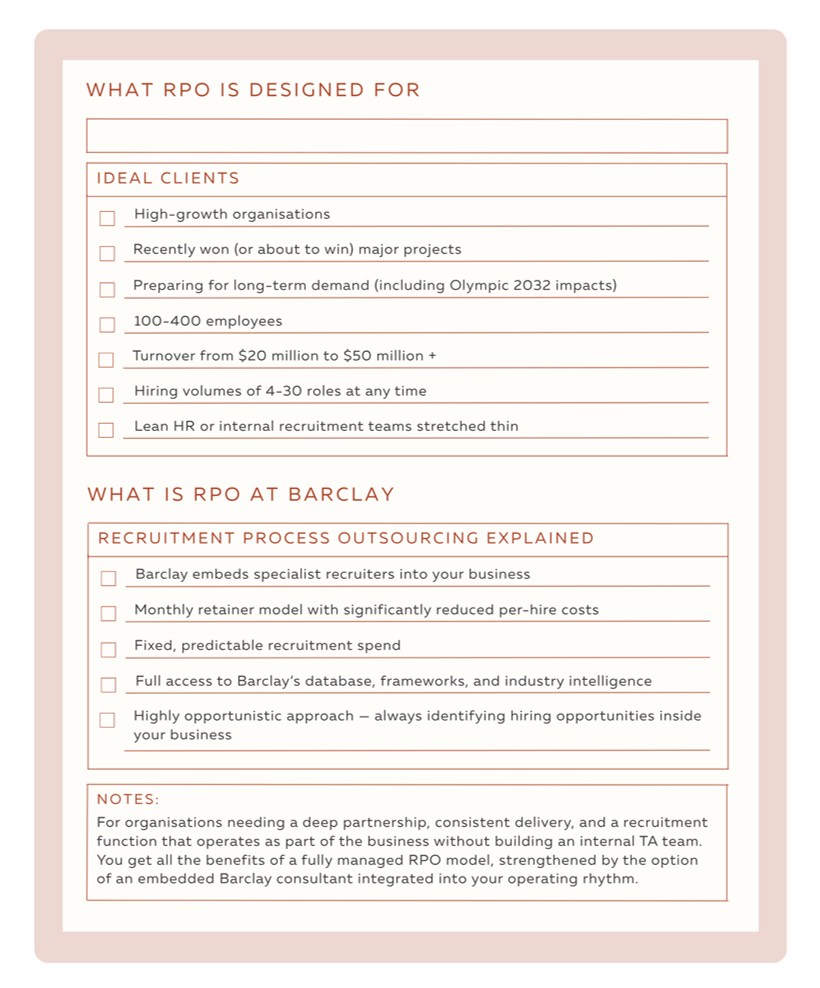
Recruitment Process Outsourcing, or RPO, is designed to shift recruitment from a reactive activity to an embedded business function.
Instead of paying per placement or trying to build and maintain an internal recruitment team from scratch, an RPO recruitment model gives the business access to dedicated recruitment capability on a predictable monthly structure.
At Barclay RPO, this means an embedded recruitment function that works as an extension of your team. Your Barclay recruiter learns your business, understands your hiring managers, builds talent pipelines and supports the full recruitment process from role briefing through to offer management and onboarding handover.
The ROI is created in several ways.
Faster hiring
Talent pipelines are built before roles become urgent. This reduces the delay between identifying a vacancy and engaging qualified candidates.
Lower cost-per-hire
A fixed monthly model can reduce reliance on repeated per-hire agency fees, particularly for businesses with consistent hiring needs.
Better quality shortlists
A structured process, specialist networks and deeper understanding of the business improve candidate alignment.
Stronger retention
When candidates are matched properly to the role, team, culture and expectations, they are more likely to stay and perform.
Clearer reporting
Performance dashboards, review rhythms and agreed metrics give leadership visibility over what recruitment is costing and where it is creating value.
Improved hiring discipline
RPO creates structure around briefing, screening, interviews, feedback, offer management and onboarding handover. That discipline reduces friction and protects candidate experience.
Recruitment ROI is not just about savings
The most valuable return is not always the most obvious one.
Yes, reducing cost-per-hire matters. So does lowering agency spend and improving time-to-fill.
But the bigger commercial benefit often comes from reducing the hidden costs that sit behind poor hiring systems.
That includes fewer prolonged vacancies, fewer rushed decisions, fewer failed hires, stronger candidate engagement and better workforce stability.
A good recruitment model does not just help the business hire. Instead, it helps the business plan, scale and deliver.
What leaders should be asking
To understand whether recruitment is delivering a return, leadership teams should be asking:
- How many critical roles are currently open?
- How long do those roles typically remain vacant?
- What is the estimated daily cost of each vacancy?
- How much internal time is being spent on recruitment?
- How much are we spending on agency fees each year?
- How many hires leave within the first 12 months?
- How often are offers declined, and why?
- Do we have a pipeline before a role becomes urgent?
- Are hiring managers aligned before the market is engaged?
- Can we clearly measure recruitment performance and ROI?
If these questions are difficult to answer, recruitment is likely costing more than the business realises.
Find out just how much → try our RPO Calculator
The Barclay Recruitment perspective
At Barclay Recruitment, we believe recruitment should do more than fill roles.
It should build capability, protect momentum and support long-term business performance.
That is why Barclay RPO is built around partnership, not transactions. The process starts with understanding the business, the hiring challenges and what success looks like. From there, the solution is designed around the client’s needs, mobilisation is structured, delivery is embedded, and performance is reviewed continuously.
This gives clients more than recruitment support. It gives them a measurable hiring function that improves over time.
Final thought
The true cost of recruitment is not found in one invoice.
It is found in the roles that stay vacant too long, the hires that do not work out, the projects that slow down and the managers who lose time trying to hold the process together.
Maximising ROI on recruitment starts with measuring the full picture.
Once you understand the true cost of not filling critical roles, the conversation changes. Recruitment is no longer just an operational task. It becomes a business performance decision.
For businesses ready to move beyond reactive hiring, Barclay RPO provides the structure, visibility and embedded capability to hire with more confidence, consistency and commercial impact.
Explore the Barclay RPO Calculator to understand what recruitment is really costing your business, and where a smarter recruitment model could deliver a stronger return.
Contact Barclay Recruitment to get started.